 |
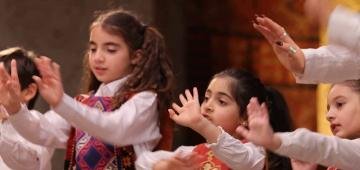
Ring the bell"Zar Zing" Komitas. At the "Mkhitar Sebastatsi" educational complex, singer and songwriter Seda Tevanyan's "Tevani" song ensemble has gathered children of all ages. They perform folk, national, and Komitas' songs. |
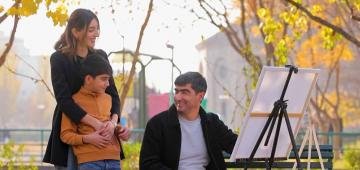 |
Hayaser HayrapetyanHayaser Hayrapetyan is from the village of Chartar, Artsakh. He was born in 1992, days after his father's death. After graduating from school, he entered the Fine Arts Department of Artsakh State University, and taught for many years in Chartar and several nearby art schools. He participated in the 44-day war as a volunteer. After the war, he continued to paint, while at the same time, he was transferred to the intelligence service in the "Martuni 3" military unit. On September 19, 2023, he was wounded in the head. After being in a coma for five days, he was taken to Yerevan by resuscitation vehicle. After being wounded, he had trouble speaking, even forgetting to write and read. Hayaser had intended to open a large exhibition in Artsakh, but his paintings and sculptures remained at home. Only a small statuette dedicated to his mother and two paintings with Artsakh landscapes were brought to Armenia. |
 |
Art and Audience: Bridging the Distance
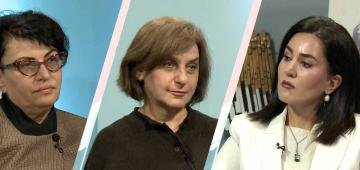
In order to fill the gaps in the field of cultural journalism and reduce the gap between the artist and society, the ARE Cultural Foundation, in partnership with the Institute of Contemporary Art, with a grant from the Embassy of the Kingdom of the Netherlands in Armenia, has initiated a free journalism course for those covering culture and art. Marine Karoyan, Founding Director of the ARE Cultural Foundation, and Narine Safaryan, Head of the Educational Department of the Media Initiatives Center, spoke about the “Art and Audience: Bridging the Gap” project at “Artfocus”. The program was hosted by art critic Anahit Margaryan.
|
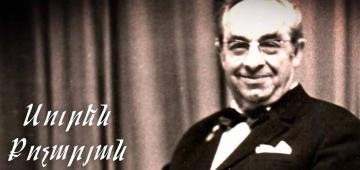 |
Suren KocharyanIn the Pavilion: Literature and Art program, prose writer Hovhannes Yeranyan tells about Suren Kocharyan, one of the most original and talented artists of Armenian and Soviet stage art. |
 |
Information vacuum regarding the situation of Armenians illegally detained in BakuWhat is the situation of our prisoners of war and other detained compatriots in Baku? What role does their country of citizenship, the Republic of Armenia, play in the demand for a fair trial? What is the progress of Armenia's interstate complaint against Azerbaijan at the International Court of Justice? Anna Sargsyan spoke with Siranush Sahakyan, President of the Center for International and Comparative Law. |
 |
One shotThe changes in the culture and mindset of short film and short films in the last decade have in turn led to a society expecting short and concise things to say. However, the magic of cinema continues to remain in the hall with the lights turned off, in the deep silence. The most important and real feeling in the history of the creation of the documentary film “Hevq” by Gagik Ghazare, a participant in the 44 Days, is the Land. There is nothing more real than the Land. |
 |
The lost sounds of dying instrumentsArmenian national musical instruments are diverse and have a history spanning thousands of years. However, today only the duduk is very popular, unlike other instruments, which are also called “dying instruments.” By rediscovering the lost sounds of dying instruments, perhaps we will be more complete and balanced. |
 |
Soviet censorship and medieval literatureDuring the Soviet period, especially in the 1930s and 1940s, Armenian medieval literature was subjected to strict censorship. Not only were the works of our medieval authors not published or were published in abbreviated form, but literary criticism also presented and interpreted them with distortions corresponding to the ruling ideology. In the program “Parallel Readings,” literary critics Hayk Hambardzumyan and Arkmenik Nikoghosyan discuss the peculiarities of the presentation of medieval literature during the Soviet years. |
 |
Rev. Father Paren ArakelyanFather Paren Arakelyan insists that the voice of the priest always reaches the right place. Every diocese has a responsible clergyman, before reaching the executive priest to the assembly, the priest first listens to the opinions of other priests serving in his diocese, and only then puts them on the table of the assembly for discussion. These questions and suggestions are assigned to a priest, who raises them with the Patriarch. Father Paren, the spiritual pastor of Saghmosavank, considers the claim that the voice of the priests is not heard to be false. He is sure that the life of the church is organized and there is no need to reorganize it. According to him, those who exclude themselves from the church are deviating. Church servants are obliged to follow and obey the rules and regulations, which are the backbone of the church. |
 |
The musical programs of the "Kayt Cultural Center""Kayt Cultural Hub" is an interdisciplinary ecosystem that unites several organizations, dozens of artists and musicians, as well as hundreds of students to ensure the life cycle of Armenian culture, from preservation to development. The acquired knowledge and experience are transformed into tangible results: books, recordings and albums, films and videos, as well as public performances, handicrafts. Tatevik Shakhkulyan, Senior Researcher of the Music Department of the Institute of Arts of the National Academy of Sciences, Candidate of Arts, Conservatory Lecturer, spoke at "Artfocus" about the musical programs of the "Kayt Cultural Hub". |
 |
National danceNational dance is the living environment where the character, value system, and historical experience of our people have been preserved. National dance reflects our spirit, our collective strength, and our inner discipline. Knowledge of national dance is not a technical skill, but a deep recognition and awareness of national identity. How did the Genocide, deportations, and repressions of the Soviet period against the Armenian people affect and what consequences did they have on national dance? |
 |
The faithful left the Mother See only after the Catholicos returned to the monasteryThe group of bishops who arrived at the Mother See by minibus, under the supervision of police officers and people in civilian clothes, tried to read a statement near the Arch of King Trdat, but as a result of the chants of the faithful, their voices were not heard. First, Bishop Anushavan Zhamkochyan tried to spread a statement on behalf of the group of bishops, then Archbishop Vazgen Mirzakhanyan. They left the territory of the Mother See accompanied by whistles from the faithful and security forces. The citizens who came to support the Catholicos of All Armenians waited until His Holiness returned from the temple to the cloister, after which they left. |