 |
Digitizing Handwritten and Printed Legacy
There is around 40 000 officially registered Armenian manuscripts in the world, and the archive documents, printed press and literature count with millions. The topic of digitizing handwritten and printed legacy is discussed by Haykanush Ghazaryan, Deputy Director on the Public Library and Gurgen Gasparyan, Coordinator of Digitization and Web Services Department of Matenadaran.
|
 |
Following the Traces of Reclamation
Thousands of Armenians subjected to Genocide had their lives insured in foreign insurance companies operating within the territory of Ottoman Empire. Talaat Pasha had requested the Ambassador of the USA Henry Morgenthau to provide the list of insured Armenians to the Turkish Government. Morgenthau later stated in his memoirs that he had refused to respond.
90 years past the Armenian Genocide, Armenian-American attorney Vartkes Yeghiayan launches a lawsuit and demanded Nuew York Lige Insurance Company to reimburse the insurance amounts of the genocide victims to their descendants. The attorney managed to secure 20 million US dollars back. The program “Option” hosts Vartkes Yeghiayan, international law expert and publicist Sago Arian.
|
 |
The Condition of Syrian Armenians in Aleppo
The war in Aleppo has got tenser, and will get even tenser turn according to the experts. There is no coordinated state program for evacuating the Syrian Armenian community, only due to private initiatives, certain families presently get to Armenia from Aleppo. Gor Gevorgyan, expert in Eastern studies and publicist Sago Arian discuss the state strategy on the mentioned issue. The discussion is attended by the Primate of the Armenian Diocese in Damascus Bishop Armash Nalbandyan via video call.
|
 |
The Church over the Years of Independence
Soviet time restrictions on religion were got rid of during the independence period, and new conditions for the Armenian Apostolic Church were made available. The legislative framework was positively changed. Mother See of Holy Etchmiadzin reviewed the structure of dioceses, reestablished the canonical and administrative life, churches were constructed and renovated for the purpose of revitalizing spiritual life, religious literature started to be published, new priests were trained. How are the cultural, educational and religious functions reflected in the life of the nation?
The topic is discussed by Father Asoghik Karapetyan and musician Vahan Artsruni.
|
 |
Ecclesiastical life 04.11.2016 Special coverage from New York
It’s been a few days since the Armenian Pontiff together with the members of the Supreme Spiritual Council of the Mother See of Holy Etchmiadzin is in New York to hold meetings at the Eastern Diocese headquarters in New York; first with Eastern, Western, and Canadian Dioceses of the Armenian Church of North America and the members of the Central Committee of the Armenian General Benevolent Union (AGBU). Next were the meetings with the members of the Supreme Spiritual Council. This is the first time ever that the Supreme Spiritual Council holds a meeting in the Eastern Diocese of the United States of America.
|
 |
History of the Relations between the Armenian Apostolic and Roman Catholic Churches
Before the 20th century, not always the relations between the Armenian Church and Roman Catholic church were smooth. Due to the ecumenic movement originating in the 20th century the doctrinal disagreements were put aside and the two churches went to face each other for the sake of Christian brotherhood and common challenges.
The topic is discussed by expert in religion Pargev Barseghyan and historian Vahe Torosyan.
|
 |
The Prospects of Syrian Conflict
6th year of Syrian war is now on its way. Syria has turned into a war platform, where interests of different states, nations, religious groups and even clans collide. Where does this conflict lead to, how does the Armenian diocese there survive?
The topic is discussed by the Primate of Armenian Diocese in Damascus Bishop Armash Nalbandyan and expert in Arabic studies Hayk Kocharyan.
|
 |
Armenian Patriarchate of Constantinople Yesterday and Today
One of the hierarchical Sees of the Mother See of Holy Etchmiadzin, Patriarchate of Constantinople, was established by the initiave of Mehmed II in middle ages. One of the key objectives then was to centralize the vast economic potential of Armenians. The Patriarchate historically played big role in uniting Armenians, organizing education and in cultural religious life. How did the role of Patriarchate of Constantinople change throughout the course of history and what circumstances are involved?
The topic is discussed by senior researcher in Maternadaran Armen Ter-Stepanyan and expert in Turkish studies Ruben Melkonyan.
|
 |
Ecclesiastical life 27.06.2016 Visit to First Christian Country
From June 24-26, Pope Francis of the Roman Catholic Church visited Armenia by the invitation of Karekin II Catholicos of All Armenians and the President of Armenia. Brief coverage of three-day visit of Pope Francis.
|
 |
Easter Sunday Divine Liturgy in the Mother See of Holy Etchmiadzin
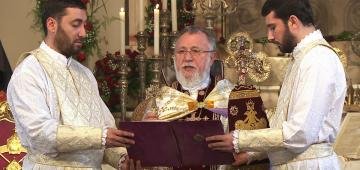
On March 27, the festive Divine Liturgy of Holy Resurrection brought the Armenian believers, state officials, representatives of various diplomatic missions, and public, political and cultural figures together in the Mother See. Catholicos of All Armenians offered a pontifical Divine Liturgy and delivered his message on the Holy Resurrection.
|
 |
The Language and Ethics of Armenian Advertisements
What language and content do the advertisements bear as they are broadcast over the Armenian television? What violations are recorded in terms of laws, language rules, ethical and moral standards? Discussed by Father Vahram Melikyan and linguist Davit Gyurjinyan.
|
 |
The Issue of Surrogacy in the Concept of the Armenian Church
Surrogacy was legalized in Armenia since 2002. Surrogate mothers helped hundreds of children come into life. The medical program of surrogacy creates an opportunity for infertile couples in Armenia to have children, raising other issues of moral and ethical nature. These issues are are discussed by the Director of the Conceptual Affairs Office of the Mother See and Primate of Tavush Diocese Bishop Bagrat Galstanyan and Chaplain of Prison Ministries Rev. Fr. Ruben Zargarian.
|